

Motorcycle Safety Camera Recording Explained
- Shiny Side Up Info
- Jun 30
- 6 min read

A close pass happens fast. One second a car sits behind you at the lights, the next it cuts across your blind side as you pull away. That is where motorcycle safety camera recording stops being a gadget and starts being a practical layer of protection. For riders who want better awareness, clear evidence and technology built for real roads, recording matters most when traffic does something unexpected.
What motorcycle safety camera recording actually does
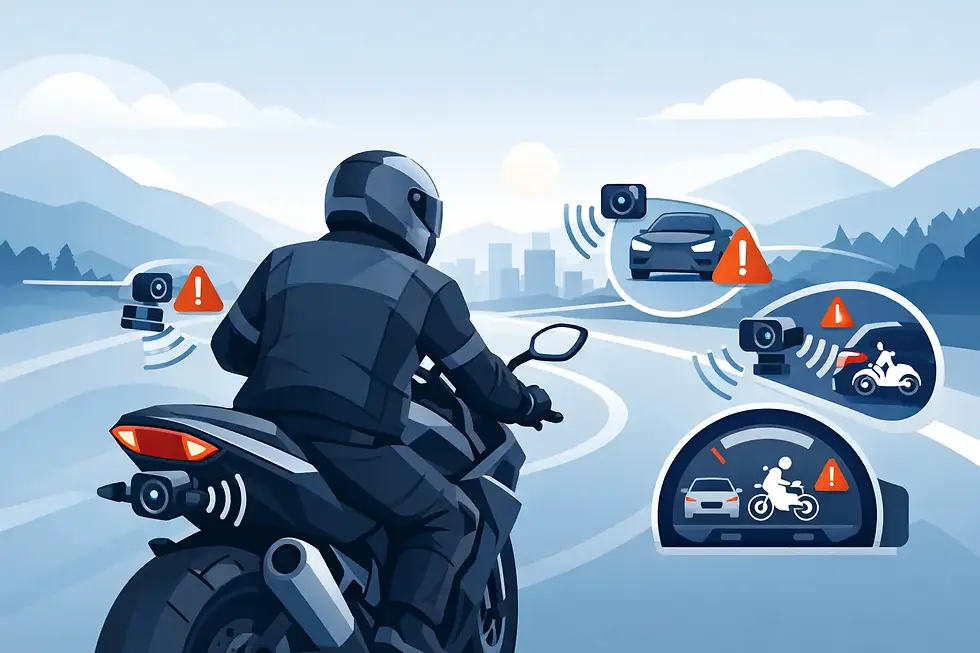
At its simplest, motorcycle safety camera recording captures what happens in front of and behind the bike while you ride. The better systems go further. They do not just save footage after an incident. They analyse what the cameras see in real time and alert you to risks as they develop.
That distinction matters. A basic action camera is useful for replaying a ride or reviewing an event after the fact. A purpose-built motorcycle safety system is designed to help you during the ride, when a vehicle enters a blind spot, closes too quickly from behind or moves into an unsafe overtaking position.
For many riders, that is the real value. Recording provides evidence. Analysis and alerts provide time. You may only gain a moment, but on a motorcycle a moment can be enough to adjust your lane position, ease off the throttle or prepare for a hazard before it becomes critical.
Why riders need more than a standard dash cam
Motorcycles do not behave like cars, and the traffic around them does not treat them like cars either. A rider is smaller in the lane, more exposed, and often overlooked by drivers checking mirrors too quickly. A standard car dash cam setup does not solve that problem well because it is usually built around a larger vehicle, fixed mounting assumptions and a driver enclosed inside a cabin.
Motorcycle safety camera recording needs to account for vibration, weather, lean angle, varied bike types and the rider's limited visual bandwidth. You cannot be staring at a screen while filtering through slow traffic or joining a fast-moving dual carriageway. Alerts have to be immediate and easy to understand.
This is why motorcycle-first systems stand apart. They are designed around rider behaviour, not adapted from automotive hardware that happens to fit on a bike. In practice, that means wide-angle front and rear coverage, compact installation, on-bike processing and warning logic that reflects the risks riders face every day.
Motorcycle safety camera recording and real-time alerts
The strongest setup combines recording with live threat detection. That means the system is not only filming the road but also interpreting it. If a vehicle approaches in a blind spot, follows too closely or presents a forward collision risk, the rider receives a visual alert while there is still time to react.
This approach is especially useful in mixed traffic. Urban commuting brings constant lane changes, hurried turns and distracted drivers. Touring adds longer hours, fatigue and unfamiliar roads. In both cases, awareness drops when the ride becomes busy or repetitive. Camera-based alerting helps bring attention back to the hazards that matter most.
There is a trade-off, of course. Any alert system has to balance sensitivity with restraint. Too many warnings become background noise. Too few and the system loses value. The best motorcycle solutions focus on actionable threats rather than trying to tell the rider everything all at once.
Recording is not just for crashes
Many riders first think about cameras as an insurance tool. That is understandable. If a collision happens, recorded footage can support your account of events and reduce disputes around blame, road position or timing. That alone makes recording worthwhile for some owners.
But day-to-day value often comes from the near misses. A camera record can show how often vehicles creep into your space in certain traffic conditions, where your blind spots feel most exposed and whether your following distance changes when you are tired or rushing. Paired with app-based ride data, recording becomes a feedback tool rather than just a witness.
That matters because safer riding is often about pattern recognition. If the footage shows repeated close overtakes on a familiar route, you may choose a different lane strategy. If junction approaches are more rushed than they feel in the moment, that is useful information. Technology cannot replace rider judgement, but it can make that judgement better informed.
What to look for in a purpose-built system
Not all recording setups deliver the same safety benefit. Video quality matters, but it is only one part of the picture. Riders should look at how the system records, where it processes data and what it can do beyond simple storage.
Front and rear coverage is essential. Many of the most dangerous interactions happen from behind or at the edge of your rearward awareness. Wide-angle cameras improve visibility around the bike, though the image must still remain clear enough to be useful.
On-device processing is another major advantage. It supports faster alerts and can reduce privacy concerns because footage and analysis do not need to be constantly sent elsewhere to function. For riders who want connected features without handing over unnecessary data, that is a sensible balance.
Installation also matters more than many expect. A system that is difficult to fit, awkward on different bike styles or vulnerable to weather is less likely to stay reliable over time. The right setup should feel integrated, not improvised.
Where motorcycle safety camera recording fits into safer riding
Camera technology is not a substitute for observation, roadcraft or training. It works best as a support layer. Riders still need disciplined mirror checks, strong positioning and a realistic understanding of stopping distances. What recording and alerts add is another line of defence when human attention is stretched.
That makes the technology especially valuable for riders who spend long hours in traffic, commute in poor weather or regularly ride in areas where driver behaviour is unpredictable. In those conditions, even experienced riders benefit from faster recognition of developing threats.
It also suits riders who want evidence without cluttering the bike with multiple devices. A unified system that records, analyses and connects to a mobile app is often more practical than piecing together separate cameras, batteries and mounts.
The role of app integration and ride data
A good mobile app should make the system easier to use, not more complicated. Riders want to review footage, check system status and understand ride events without dealing with clumsy menus or constant manual upkeep.
Ride data can be useful when it stays focused on rider outcomes. Reviewing alerts, recorded events and route-specific patterns helps turn raw footage into something actionable. You are not collecting data for its own sake. You are using it to understand what the system detected and how your riding environment is changing.
This is where a product such as the Ride Vision 2 Pro fits naturally. It combines front and rear cameras, real-time hazard analysis, ride recording and app connectivity in a package designed specifically for motorcycles. The practical benefit is straightforward - it helps riders see more, react sooner and keep a record when the road does not go to plan.
Is it worth it for every rider?
It depends on how and where you ride. If your bike only comes out on quiet Sunday mornings, the urgency may feel lower. If you commute daily, travel in dense traffic or cover serious mileage through changing conditions, the value becomes easier to justify.
There is also the question of what kind of reassurance you want. Some riders only care about evidence after an incident. Others want active warnings that help reduce risk in the first place. Motorcycle safety camera recording can serve both needs, but the right system depends on whether your priority is documentation, awareness or both.
For most riders, the strongest case is simple. You are exposed, traffic is inconsistent and hazards rarely announce themselves early. A camera system that records the ride and warns you about what is developing around the bike gives you more useful information when it counts.
The best safety technology does not distract from the ride. It supports the decisions you already make, adds clarity where visibility is limited and helps you stay one step ahead of the mistakes other road users make. If a system can do that consistently, it has earned its place on the bike.


Comments