

Motorcycle Dash Cam With Alerts Explained
- Shiny Side Up Info
- Jun 29
- 6 min read

A close pass from behind gives you almost no time to react. A vehicle sitting in your blind spot can stay hidden until you change position. That is exactly where a motorcycle dash cam with alerts moves beyond simple recording and becomes a real safety tool. It does not just capture what happened after the fact. It analyses what is happening around the bike and warns you while there is still time to respond.
For many riders, the phrase dash cam still suggests evidence capture first and safety second. That made sense when most camera systems were built mainly to record footage. On a motorcycle, though, recording alone only solves part of the problem. Riders need support in motion - especially in mixed traffic, at junctions, on dual carriageways, and during filtering where hazards develop quickly and often from more than one direction.
What makes a motorcycle dash cam with alerts different
A standard motorcycle camera setup records the road ahead, the road behind, or both. That can be useful for insurance claims, incident review, and documenting a ride. But if the system only stores footage, it is passive. It helps after a near miss or collision, not during it.
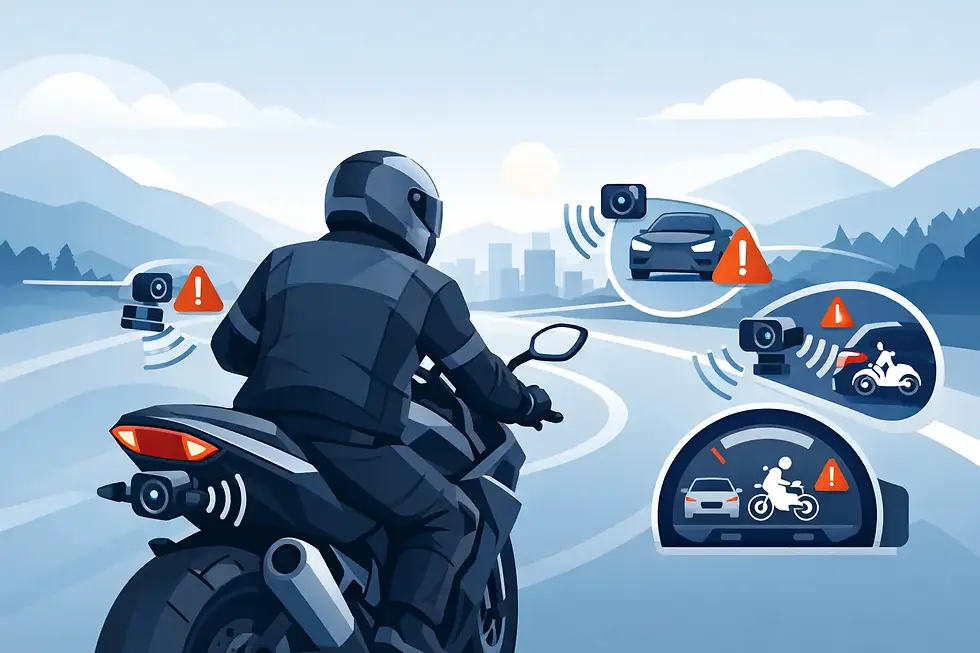
A motorcycle dash cam with alerts adds active rider assistance. Using front and rear cameras, onboard processing, and threat-detection software, it monitors road conditions in real time. When the system identifies a meaningful risk - such as a vehicle in a blind spot, a fast-approaching vehicle from the rear, or a forward collision threat - it delivers a visible warning to the rider.
That difference matters. Riders do not need more distraction. They need earlier awareness. A well-designed alert system should give clear, timely warnings without feeling like an automotive feature forced onto a bike.
Why motorcycle-specific alerts matter
Motorcycles behave differently from cars, and traffic behaves differently around motorcycles. Riders change lane position for visibility, manage lean angle through bends, filter through slower traffic, and deal with smaller visual profiles that other road users often miss. A system adapted from car technology can struggle in that environment.
Motorcycle-specific design is not a marketing extra. It affects how cameras are positioned, how motion is interpreted, how alerts are delivered, and how the unit copes with vibration, weather, and varied bike types. It also affects whether the system feels useful on a daily commute or becomes something the rider ignores after a week.
This is where purpose-built systems stand apart. Rather than treating the bike like a small car, they account for real rider behaviour and the way hazards build in motorcycle traffic scenarios. That includes overtakes that close too quickly, vehicles hanging just off the rear quarter, and changing following distances in stop-start conditions.
The alerts that actually help on the road
Not every warning deserves your attention. If a system flags harmless traffic movements too often, riders start tuning it out. The best alert-based dash cam systems focus on practical threats that riders face every day.
Blind spot alerts are among the most useful. A vehicle can sit just behind and to the side of the bike, especially on multi-lane roads, where mirrors and shoulder checks may not give a complete picture. A timely visual warning helps the rider confirm the risk before changing line or lane.
Forward collision alerts also have real value, particularly in urban traffic and on faster roads where closing speeds change suddenly. If a vehicle ahead brakes hard or traffic compresses faster than expected, an early cue can support quicker decision-making.
Rear collision awareness is another strong advantage. Riders are vulnerable when slowing for traffic, approaching junctions, or waiting at lights. A system that analyses rear approach speed can help the rider recognise when a following vehicle may not be reacting safely.
Dangerous overtaking alerts can also make a difference. On open roads and dual carriageways, vehicles sometimes pass too closely or cut back in early. A system that highlights this behaviour supports awareness in situations where the rider has limited room to adjust.
Recording still matters - but it should not be the only feature
There is a reason riders want cameras on their bikes. Footage can support insurance claims, clarify fault, and provide valuable context after an incident. It can also help riders review their road positioning and decision-making. That is all worthwhile.
Still, recording by itself has limits. It does not warn you about the vehicle building in your blind spot. It does not tell you that traffic ahead is closing quickly. It does not reduce the delay between hazard development and rider awareness.
The strongest systems combine both functions. They record the ride continuously while also analysing traffic conditions in real time. That means the same hardware that helps document an event may also help you avoid one.
What to look for in a motorcycle dash cam with alerts
If you are comparing systems, start with how the alerts work, not just camera resolution. Crisp footage is useful, but rider safety depends more on detection quality, reliability, and how well the system suits motorcycle use.
Look for front and rear wide-angle cameras. Hazard detection is only as good as the view the system has around the bike. Coverage needs to reflect real riding conditions, including vehicles approaching from offset angles rather than only directly ahead or behind.
On-device processing is another important point. Systems that analyse road conditions locally can respond quickly and reduce dependence on constant cloud handling. That supports both speed and privacy, which matters to riders who want safety tech without unnecessary data exposure.
Alert delivery also needs attention. Warnings should be visible, immediate, and easy to interpret at a glance. If an alert is confusing or arrives too late, it adds little value. The goal is not to overload the rider with information. The goal is to improve awareness without clutter.
Installation flexibility should not be overlooked either. Motorcycles vary widely in fairing layouts, tail sections, riding positions, and electrical setups. A practical system needs to fit different bike types without becoming an engineering project.
Where these systems help most
Commuters often see the clearest benefit because they spend time in dense traffic with frequent lane changes, roundabouts, buses, vans, and unpredictable braking. Alerts can support awareness in exactly the kind of stop-start riding where risks build quickly.
Touring riders benefit in a different way. Long hours in the saddle can bring fatigue, changing weather, and unfamiliar roads. A system that keeps monitoring front and rear threats adds another layer of support when concentration is under pressure.
Safety-focused enthusiasts and weekend riders also have good reason to consider alert-based systems. Faster roads, variable traffic speeds, and overtaking scenarios all increase the value of earlier hazard recognition. Even experienced riders cannot see everything at once.
The trade-offs to understand
No rider-assistance system should be treated as a substitute for skill, mirrors, shoulder checks, or roadcraft. Alerts are there to support your awareness, not replace it. The best way to think about them is as an extra set of eyes that never gets tired, while the rider remains fully responsible for the decision.
It is also fair to say that not every rider wants the same level of technology. Some prefer a simple recorder and nothing more. Others want active protection because they ride daily in heavy traffic or have already had too many close calls. It depends on where, how, and how often you ride.
There is also a quality gap in the market. Some products offer basic recording and present it as safety technology. Others are built around real-time threat detection from the ground up. That distinction is worth understanding before you buy.
Why purpose-built systems are gaining attention
As rider-assistance technology improves, more motorcyclists are looking for systems that do more than archive footage. They want practical protection that fits the realities of riding. That means visible alerts, dependable detection, useful video evidence, and app support that helps them review rides without turning safety into a chore.
Rider Shield 360 Canada focuses on that category of system. Its approach centres on motorcycle-first hardware and patented real-time analysis that detects threats around the bike while recording the ride. For riders who want safety technology that feels designed for motorcycles rather than borrowed from cars, that is the direction the market is moving.
A good camera can help explain what happened. A good alert system can help you spot trouble sooner. If your current setup only records the aftermath, it may be worth asking whether your next system should do more to keep you safe before the critical moment arrives.


Comments