

Motorcycle Collision Avoidance System Explained
- Shiny Side Up Info
- Jun 20
- 5 min read

A rider glancing over a shoulder in dense traffic has about a second to spot a fast-moving car, judge the gap, and decide whether to move. That is exactly where a motorcycle collision avoidance system earns its place. It adds another layer of awareness when traffic gets messy, visibility changes, or another road user does something careless.
For motorcyclists, the issue is not simply avoiding impact. It is managing risk in an environment where blind spots, sudden lane changes, tailgating, and unsafe overtakes happen constantly. A modern rider-assistance system is built to watch what you cannot always watch at the same time, then warn you early enough to react.
What a motorcycle collision avoidance system actually does
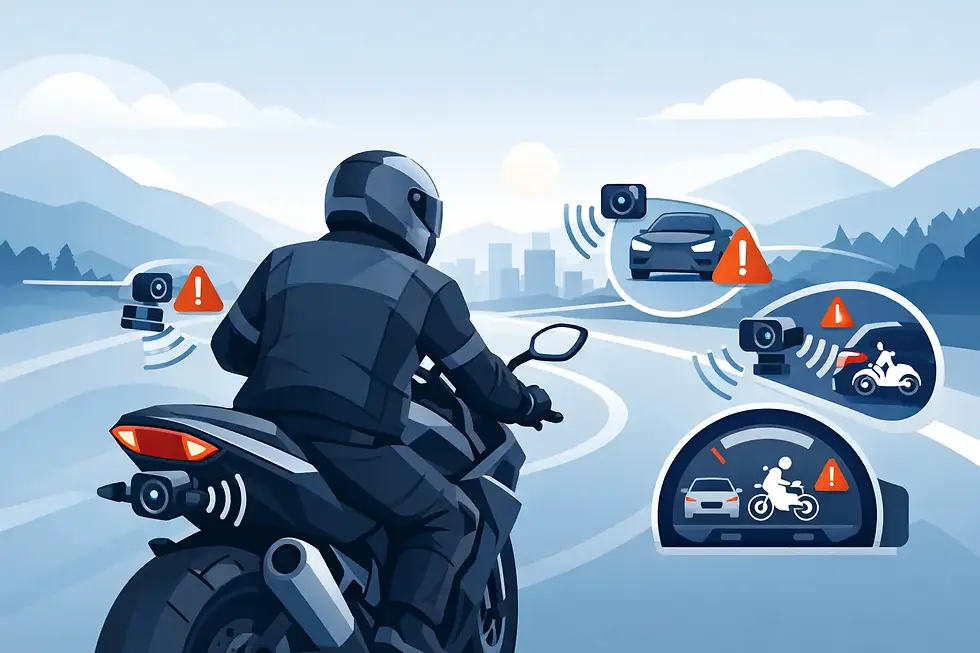
A motorcycle collision avoidance system uses cameras, onboard processing, and rider alerts to identify threats around the bike in real time. Unlike many car-based safety systems, the best motorcycle versions are designed around the way a bike moves, leans, filters through traffic, and changes position within a lane.
That distinction matters. A motorcycle does not behave like a car, and riders do not need bulky driver-assistance features that feel intrusive or overcomplicated. They need fast, clear information that supports decision-making without taking over the ride.
In practical terms, the system is there to monitor key risk areas. That usually includes vehicles in blind spots, closing traffic behind you, forward collision risks, dangerous passing manoeuvres, and following distances that are becoming unsafe. The goal is not to ride for you. The goal is to give you timely awareness when your own vision and mirrors are under pressure.
Why motorcycle-specific design matters
Plenty of safety technology sounds impressive on paper, but motorcycles demand a different standard. Vibration, weather exposure, compact mounting space, lean angles, changing road surfaces, and rider posture all affect how a system performs.
A proper motorcycle collision avoidance system needs to do more than detect motion. It needs to interpret road behaviour in a way that makes sense for riders. That means wide-angle visibility, fast onboard analysis, and alerts that are easy to understand at a glance.
It also means the system should not rely on the same assumptions used in cars. Automotive solutions are often built for enclosed cabins, fixed screens, and larger vehicle footprints. On a motorcycle, every alert has to be useful immediately. If the warning is distracting, delayed, or difficult to read, it loses value.
How the technology works on the road
Most advanced systems use front and rear cameras to watch the riding environment continuously. These cameras feed video into an onboard processor that analyses movement, distance, relative speed, and vehicle position. When the system identifies a credible threat, it delivers a visual alert so the rider can respond.
That process happens in real time. The point is not to review danger after the fact. It is to catch developing risks while there is still room to brake, hold position, or avoid moving into conflict.
This is especially useful in the situations riders deal with every week. A vehicle may sit just off your rear quarter where mirrors do not give you the full picture. A car ahead may slow harder than expected while another driver crowds from behind. Someone may start an overtake without enough clearance. A warning system helps bring those threats forward before they become emergencies.
The alerts that make the biggest difference
Not every warning has equal value. Riders benefit most from alerts tied to common, high-consequence risks.
Blind spot detection is one of the strongest examples. Shoulder checks still matter, but in busy traffic there are moments when another vehicle slips into a hard-to-see area just as you are preparing to move. A clear visual warning helps confirm that the lane is not as open as it looked.
Forward collision warnings are equally important, particularly in stop-start commuting and fast-changing urban traffic. Riders often need to process brake lights, road surface conditions, escape routes, and surrounding vehicles all at once. An extra prompt when the closing gap becomes risky can improve reaction time.
Dangerous overtake and unsafe following alerts matter for a different reason. Many collisions begin with pressure from behind or from the side rather than a direct mistake by the rider. When a system flags that behaviour early, it gives you more time to create space, adjust lane position, or delay a manoeuvre.
Recording and data are more useful than many riders expect
Video recording is often treated as a secondary feature, but it has clear practical value. If an incident happens, recorded footage can help establish what occurred. That may support insurance claims, provide evidence after a near miss, or simply help a rider review a situation more accurately.
Ride data can also improve habits over time. A connected app can show where alerts occur most often, how frequently following-distance warnings appear, or what patterns emerge in certain traffic conditions. For riders who care about being prepared, that information is not gimmicky. It can shape better decisions on route choice, spacing, and positioning.
There is a privacy angle here too. Many riders want safety technology without constant cloud dependence or unnecessary data exposure. Systems that process core safety functions on the device itself can offer a better balance between connected features and rider privacy.
What to look for in a motorcycle collision avoidance system
The right system should feel like part of the bike, not a complicated add-on. Strong threat detection is the priority, but day-to-day usability matters just as much.
Look for a setup with front and rear coverage, purpose-built motorcycle mounting, and visual alerts that remain clear in real riding conditions. App integration can be valuable if it supports setup, video access, and ride insights without making the system fiddly. Installation flexibility is also important because riders use everything from commuters and tourers to nakeds, cruisers, and adventure bikes.
Reliability matters more than an overloaded feature list. A smaller set of well-executed functions is usually better than a long menu of features that are slow, distracting, or poorly adapted to motorcycles.
Trade-offs riders should understand
No system replaces rider judgement. That is the first point. A motorcycle collision avoidance system is an assistance tool, not an autopilot, and the best results come when riders use it to support good scanning, positioning, and decision-making.
There is also the question of expectations. Some riders assume technology should eliminate risk entirely. It cannot. What it can do is improve awareness, reduce missed hazards, and help riders react earlier. That is a meaningful advantage, but it is still one part of a wider safety approach.
It also depends on the riding environment. Urban commuters may benefit most from blind spot and forward collision alerts because traffic density is high and vehicle behaviour changes quickly. Touring riders may value rear awareness and ride recording over long distances. The right fit depends on where and how you ride.
Why this matters more now
Traffic is faster, more distracted, and less predictable than many riders remember. Drivers rely on screens, rush lane changes, and misjudge motorcycles far too often. Riders cannot control that behaviour, but they can add tools that improve their own awareness.
That is why interest in motorcycle-first safety technology keeps growing. Riders want practical protection without giving up control. They want systems that analyse and alert, record the ride, and fit the realities of motorcycling rather than forcing a car-tech approach onto two wheels.
A purpose-built platform such as Ride Vision 2 Pro reflects that shift clearly. It uses patented camera- and algorithm-based detection designed specifically for motorcycles, with real-time alerts, ride recording, and connected insights that support everyday riding decisions.
The best time to spot a threat is before it forces a panic response. If your bike can help you see more, react sooner, and ride with better awareness, that is not extra tech for the sake of it. It is a practical step towards staying upright and getting home safely.


Comments