
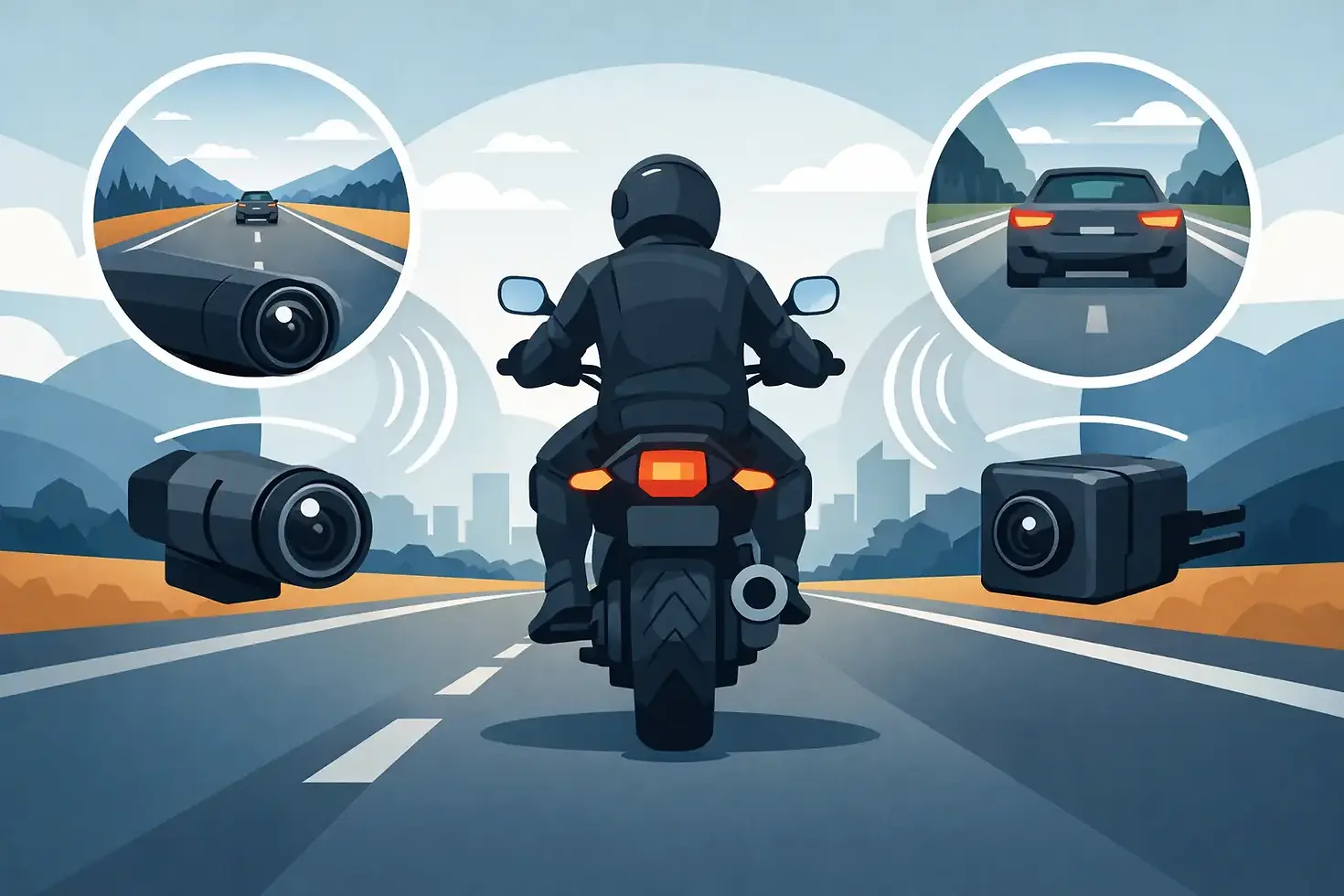
Enhancing Safety with Front and Rear Motorcycle Cameras

Updated: Aug 3
Why Front and Rear Motorcycle Cameras Matter
A single forward-facing camera can record what happens ahead, but it leaves a significant gap behind the motorcycle. A rear camera fills that gap, monitoring following traffic, vehicles approaching from behind, and movement in areas that are difficult to check without diverting attention from the road.
The benefit is not that a camera replaces rider awareness. It cannot. Safe observation, mirror checks, shoulder checks, and good road positioning still matter. The value lies in a dual-camera system that can analyze more of the traffic picture simultaneously and alert you when a risk needs attention.
This is especially useful on busy urban routes, dual carriageways, and long motorway journeys. In these environments, risk often develops through closing speed and changing vehicle position rather than one dramatic event. A car may begin an unsafe overtake. A lorry may move across lanes. A following driver may leave too little space. Early awareness gives you more options: adjust your position, increase the gap, ease off the throttle, or prepare to brake.
A Wider View Without Constant Distraction
Mirrors are essential, but they have limits. Their view changes with vibration, rider posture, luggage, and the motorcycle’s design. Blind spots remain blind spots, particularly when traffic moves at different speeds.
Wide-angle front and rear cameras extend the motorcycle’s field of view. The key word is extend, not replace. A useful system should provide a clear alert when it detects a relevant threat, rather than asking you to watch another screen continuously. You remain in control; the technology helps direct attention at the right moment.
The Value of Real-Time Alerts
Many riders first consider cameras for evidence. That is a sensible reason. A recorded ride can help establish what occurred after a collision, dangerous maneuver, or disputed incident. Footage can also be useful when reviewing an unfamiliar route or identifying patterns in close calls.
However, recording alone is reactive. You only benefit after something has happened. The stronger safety case for front and rear motorcycle cameras comes from combining video with real-time analysis.
A motorcycle rider-assistance system can use its camera feeds and algorithms to identify developing risks, such as forward collision danger, unsafe following distance, a vehicle in a blind spot, or a dangerous overtake. It can then provide immediate visual alerts designed for use on a motorcycle. That distinction matters. A conventional dash camera records; an intelligent motorcycle system analyzes and alerts.
Ride Vision 2 Pro is built around this motorcycle-first approach, using front and rear wide-angle cameras with onboard processing to detect and warn of road threats while recording the ride. Its purpose is not to overload riders with data. It is to make critical traffic movement easier to recognize before it becomes urgent.
What a Useful Alert Should Do
An alert must be timely, relevant, and easy to understand. If warnings arrive too late, they offer little room to respond. If they appear constantly in ordinary traffic, riders may learn to ignore them.
That is why motorcycle-specific calibration matters. Motorcycles move differently from cars. They can filter, lean, change road position, and accelerate or decelerate more quickly. A system designed around actual riding behavior has a better chance of delivering warnings that support rather than interrupt the ride.
No warning system can predict every driver’s action or remove the possibility of a collision. Weather, camera visibility, road layout, and the behavior of surrounding vehicles all affect performance. Treat alerts as an additional prompt to assess the situation, never as permission to take more risks.
Choosing Front and Rear Motorcycle Cameras
The best setup depends on what you want from it. If your only priority is recording scenic rides, a basic camera arrangement may suffice. If you commute in dense traffic, cover motorway miles, or regularly ride with luggage and passengers, an integrated safety system may provide a more meaningful return.
Look beyond video resolution. Clear footage is useful, but a high-resolution camera with poor mounting, weak weather protection, or no practical way to retrieve recordings will disappoint. Likewise, a camera system that floods you with notifications may create distraction instead of confidence.
When comparing options, assess these practical points:
Front and rear coverage: Both directions should be covered, with wide-angle views positioned to see relevant traffic movement.
Real-time threat detection: Check whether the system only records or can identify risks such as blind-spot vehicles, forward collision threats, and unsafe overtakes.
Alert method: Warnings should be visible and understandable without forcing your eyes away from the road for long.
Onboard processing and privacy: Processing video on the device can reduce dependence on constant cloud uploads and keep control of ride data closer to you.
Installation compatibility: The system should suit the motorcycle’s fairing, tail section, power supply, and everyday use, whether you ride a commuter, naked, tourer, or adventure bike.
App and footage access: A mobile app should make it straightforward to review recordings, manage settings, and inspect ride information without turning routine tasks into a technical project.
Installation Affects Performance
Camera placement is not an afterthought. A front camera needs an unobstructed view that is stable under vibration and protected from avoidable spray or debris. A rear camera must see approaching traffic without being blocked by a number plate, luggage, mudguard, or panniers.
Cable routing also deserves care. Wires should be secured away from steering movement, hot engine components, sharp edges, and suspension travel. Power connections need to be reliable, weather-conscious, and appropriate for the motorcycle’s electrical system. Poor installation can lead to vibration in footage, unreliable operation, or a camera angle that misses the very traffic it is meant to monitor.
For riders who change motorcycles or use different machine types, installation flexibility is a real consideration. A good system should be designed for motorcycles, not awkwardly adapted from a car product with assumptions that do not fit a bike.
Where Cameras Help Most on Real Roads
Front and rear coverage is valuable in several familiar situations. On a motorway, rear monitoring can make you more aware of fast-approaching vehicles before a lane change. In town, forward monitoring can support your own observation as traffic brakes unexpectedly, pedestrians step out, or vehicles turn across your path.
Filtering is another area where riders face constant movement around them. Cars may change lanes without signaling, doors may open, and gaps can disappear quickly. Cameras cannot make filtering risk-free, but an early warning of a vehicle’s position or movement can add useful context during a high-workload maneuver.
On rural roads, the benefit may be less about congestion and more about evidence and forward awareness. An oncoming vehicle cutting a bend, an overtake that develops badly, or debris appearing after a blind crest can all leave little time to respond. The camera system supports alertness, but sensible speed and a view that lets you stop in the distance you can see remain the foundation.
Use the Technology Without Becoming Dependent on It
The best rider-assistance technology fits into disciplined riding habits. Set the alerts up before a journey, keep camera lenses clean, and check mounting points regularly. Review footage when there is a useful reason, such as a near miss or a route you want to understand better, rather than treating every ride as content to sort through.
Most importantly, keep your riding plan independent of the system. Scan well ahead, leave space, use mirrors actively, and expect other road users to make mistakes. Cameras and alerts work best when they reinforce those habits.
A well-chosen dual-camera system gives you a clearer picture of the traffic around your motorcycle, records the moments that matter, and helps bring developing hazards to your attention sooner. That extra awareness cannot control the road, but it can give you more time to make the calm, deliberate decision that keeps a ride on track.


Comments